

Plane Perpendicular To A Line
Lines and planes are perhaps the simplest of curves and surfaces in 3 dimensional space. They also will prove important equally nosotros seek to understand more than complicated curves and surfaces.
The equation of a line in two dimensions is $ax+by=c$; it is reasonable to expect that a line in three dimensions is given by $ax + by +cz = d$; reasonable, but wrong—information technology turns out that this is the equation of a airplane.
A plane does non have an obvious "management'' equally does a line. Information technology is possible to associate a plane with a management in a very useful manner, still: in that location are exactly two directions perpendicular to a airplane. Any vector with one of these two directions is called normal to the plane. So while there are many normal vectors to a given plane, they are all parallel or anti-parallel to each other.
Suppose two points $\ds (v_1,v_2,v_3)$ and $\ds (w_1,w_2,w_3)$ are in a aeroplane; and so the vector $\ds \langle w_1-v_1,w_2-v_2,w_3-v_3\rangle$ is parallel to the airplane; in particular, if this vector is placed with its tail at $\ds (v_1,v_2,v_3)$ then its head is at $\ds (w_1,w_2,w_3)$ and it lies in the airplane. As a outcome, any vector perpendicular to the plane is perpendicular to $\ds \langle w_1-v_1,w_2-v_2,w_3-v_3\rangle$. In fact, it is easy to run across that the aeroplane consists of precisely those points $\ds (w_1,w_2,w_3)$ for which $\ds \langle w_1-v_1,w_2-v_2,w_3-v_3\rangle$ is perpendicular to a normal to the aeroplane, as indicated in figure 12.5.i. That is, suppose we know that $\langle a,b,c\rangle$ is normal to a airplane containing the point $\ds (v_1,v_2,v_3)$. Then $(x,y,z)$ is in the airplane if and merely if $\langle a,b,c\rangle$ is perpendicular to $\ds \langle ten-v_1,y-v_2,z-v_3\rangle$. In turn, we know that this is truthful precisely when $\ds \langle a,b,c\rangle\cdot\langle 10-v_1,y-v_2,z-v_3\rangle=0$. Thus, $(10,y,z)$ is in the plane if and only if $$\eqalign{ \langle a,b,c\rangle\cdot\langle x-v_1,y-v_2,z-v_3\rangle&=0\cr a(x-v_1)+b(y-v_2)+c(z-v_3)&=0\cr ax+past+cz-av_1-bv_2-cv_3&=0\cr ax+by+cz&=av_1+bv_2+cv_3.\cr }$$ Working backwards, annotation that if $(x,y,z)$ is a signal satisfying $ax+by+cz=d$ then $$\eqalign{ ax+by+cz&=d\cr ax+past+cz-d&=0\cr a(x-d/a)+b(y-0)+c(z-0)&=0\cr \langle a,b,c\rangle\cdot\langle ten-d/a,y,z\rangle&=0.\cr }$$ Namely, $\langle a,b,c\rangle$ is perpendicular to the vector with tail at $(d/a,0,0)$ and head at $(x,y,z)$. This means that the points $(x,y,z)$ that satisfy the equation $ax+by+cz=d$ form a plane perpendicular to $\langle a,b,c\rangle$. (This doesn't piece of work if $a=0$, merely in that instance we can use $b$ or $c$ in the part of $a$. That is, either $a(x-0)+b(y-d/b)+c(z-0)=0$ or $a(x-0)+b(y-0)+c(z-d/c)=0$.)
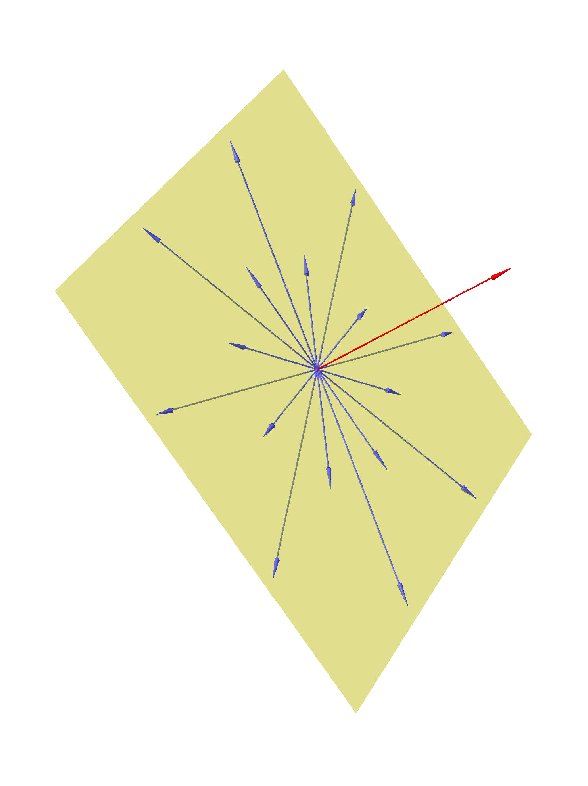
Figure 12.5.1. A plane defined via vectors perpendicular to a normal.
Thus, given a vector $\langle a,b,c\rangle$ we know that all planes perpendicular to this vector have the form $ax+past+cz=d$, and whatever surface of this grade is a plane perpendicular to $\langle a,b,c\rangle$.
Example 12.5.1 Observe an equation for the plane perpendicular to $\langle 1,2,3\rangle$ and containing the point $(5,0,7)$.
Using the derivation above, the aeroplane is $1x+2y+3z=1\cdot5+two\cdot0+3\cdot7=26$. Alternately, we know that the aeroplane is $x+2y+3z=d$, and to find $d$ we may substitute the known betoken on the aeroplane to get $5+two\cdot0+3\cdot7=d$, so $d=26$. We could besides write this simply as $(10-5)+2(y)+3(z-seven)=0$, which is for many purposes a fine representation; it tin always exist multiplied out to give $x+2y+3z=26$. $\square$
Case 12.five.2 Find a vector normal to the plane $2x-3y+z=xv$.
One example is $\langle 2, -3,1\rangle$. Any vector parallel or anti-parallel to this works as well, so for example $-2\langle 2, -3,1\rangle=\langle -four,half-dozen,-2\rangle$ is also normal to the airplane. $\square$
Nosotros volition oftentimes demand to notice an equation for a airplane given certain information well-nigh the airplane. While there may occasionally exist slightly shorter ways to get to the desired outcome, it is always possible, and normally advisable, to use the given data to find a normal to the airplane and a point on the aeroplane, and and so to find the equation as above.
Example 12.5.three The planes $x-z=1$ and $y+2z=3$ intersect in a line. Find a 3rd plane that contains this line and is perpendicular to the plane $x+y-2z=ane$.
First, nosotros notation that ii planes are perpendicular if and only if their normal vectors are perpendicular. Thus, nosotros seek a vector $\langle a,b,c\rangle$ that is perpendicular to $\langle 1,i,-ii\rangle$. In add-on, since the desired plane is to incorporate a sure line, $\langle a,b,c\rangle$ must be perpendicular to any vector parallel to this line. Since $\langle a,b,c\rangle$ must exist perpendicular to two vectors, nosotros may find information technology by calculating the cross production of the ii. So we need a vector parallel to the line of intersection of the given planes. For this, information technology suffices to know two points on the line. To find two points on this line, we must find two points that are simultaneously on the 2 planes, $10-z=1$ and $y+2z=iii$. Any indicate on both planes volition satisfy $x-z=1$ and $y+2z=3$. It is like shooting fish in a barrel to notice values for $10$ and $z$ satisfying the beginning, such equally $ten=1, z=0$ and $x=two, z=1$. So we can notice corresponding values for $y$ using the second equation, namely $y=3$ and $y=i$, and so $(one,3,0)$ and $(2,1,i)$ are both on the line of intersection considering both are on both planes. Now $\langle 2-1,one-3,1-0\rangle=\langle ane,-two,i\rangle$ is parallel to the line. Finally, we may choose $\langle a,b,c\rangle=\langle one,1,-2\rangle\times \langle one,-2,one\rangle=\langle -3,-three,-3\rangle$. While this vector will do perfectly well, any vector parallel or anti-parallel to it will piece of work also, so for example nosotros might choose $\langle 1,1,ane\rangle$ which is anti-parallel to it.
Now nosotros know that $\langle 1,1,one\rangle$ is normal to the desired airplane and $(2,1,one)$ is a signal on the airplane. Therefore an equation of the plane is $x+y+z=iv$. As a quick check, since $(ane,iii,0)$ is also on the line, information technology should be on the plane; since $i+3+0=4$, we run across that this is indeed the example.
Note that had we used $\langle -3,-3,-3\rangle$ as the normal, we would have discovered the equation $-3x-3y-3z=-12$, then we might well have noticed that we could divide both sides by $-three$ to get the equivalent $x+y+z=iv$. $\foursquare$
And so we at present sympathize equations of planes; permit us turn to lines. Unfortunately, it turns out to be quite inconvenient to correspond a typical line with a single equation; we need to approach lines in a different way.
Unlike a airplane, a line in iii dimensions does accept an obvious direction, namely, the direction of any vector parallel to it. In fact a line can be defined and uniquely identified by providing i signal on the line and a vector parallel to the line (in one of two possible directions). That is, the line consists of exactly those points nosotros tin reach by starting at the point and going for some distance in the management of the vector. Allow's see how nosotros can interpret this into more mathematical language.
Suppose a line contains the point $\ds (v_1,v_2,v_3)$ and is parallel to the vector $\langle a,b,c\rangle$; we call $\langle a,b,c\rangle$ a direction vector for the line. If we identify the vector $\ds \langle v_1,v_2,v_3\rangle$ with its tail at the origin and its caput at $\ds (v_1,v_2,v_3)$, and if nosotros place the vector $\langle a,b,c\rangle$ with its tail at $\ds (v_1,v_2,v_3)$, then the head of $\langle a,b,c\rangle$ is at a bespeak on the line. We can go to any signal on the line past doing the same thing, except using $t\langle a,b,c\rangle$ in place of $\langle a,b,c\rangle$, where $t$ is some real number. Considering of the way vector addition works, the indicate at the head of the vector $t\langle a,b,c\rangle$ is the betoken at the head of the vector $\ds \langle v_1,v_2,v_3\rangle+t\langle a,b,c\rangle$, namely $\ds (v_1+ta,v_2+tb,v_3+tc)$; run across figure 12.5.ii.
Effigy 12.5.two. Vector course of a line.
In other words, as $t$ runs through all possible real values, the vector $\ds \langle v_1,v_2,v_3\rangle+t\langle a,b,c\rangle$ points to every point on the line when its tail is placed at the origin. Some other common way to write this is every bit a set of parametric equations: $$ x= v_1+ta\qquad y=v_2+tb \qquad z=v_3+tc.$$ It is occasionally useful to use this form of a line even in 2 dimensions; a vector form for a line in the $x$-$y$ aeroplane is $\ds \langle v_1,v_2\rangle+t\langle a,b\rangle$, which is the same equally $\ds \langle v_1,v_2,0\rangle+t\langle a,b,0\rangle$.
Example 12.v.iv Detect a vector expression for the line through $(6,1,-3)$ and $(ii,4,5)$. To get a vector parallel to the line we subtract $\langle 6,1,-iii\rangle-\langle2,iv,v\rangle=\langle 4,-three,-8\rangle$. The line is and so given by $\langle 2,4,5\rangle+t\langle 4,-3,-8\rangle$; there are of course many other possibilities, such as $\langle 6,1,-3\rangle+t\langle 4,-3,-8\rangle$. $\square$
Example 12.v.v Determine whether the lines $\langle i,1,ane\rangle+t\langle 1,2,-ane\rangle$ and $\langle 3,2,1\rangle+t\langle -1,-5,iii\rangle$ are parallel, intersect, or neither.
In two dimensions, 2 lines either intersect or are parallel; in three dimensions, lines that do not intersect might non exist parallel. In this case, since the management vectors for the lines are non parallel or anti-parallel we know the lines are not parallel. If they intersect, there must be two values $a$ and $b$ so that $\langle 1,1,1\rangle+a\langle 1,ii,-ane\rangle= \langle 3,2,1\rangle+b\langle -1,-5,3\rangle$, that is, $$\eqalign{ 1+a&=3-b\cr ane+2a&=2-5b\cr one-a&=one+3b\cr }$$ This gives three equations in two unknowns, and then there may or may not be a solution in general. In this case, information technology is easy to discover that $a=iii$ and $b=-one$ satisfies all three equations, so the lines do intersect at the betoken $(4,7,-ii)$. $\square$
Example 12.v.half-dozen Detect the altitude from the point $(i,2,3)$ to the plane $2x-y+3z=five$. The distance from a point $P$ to a plane is the shortest distance from $P$ to any signal on the airplane; this is the distance measured from $P$ perpendicular to the plane; see effigy 12.5.3. This altitude is the absolute value of the scalar projection of $\ds \overrightarrow{\strut QP}$ onto a normal vector $\bf north$, where $Q$ is any bespeak on the plane. It is easy to find a point on the aeroplane, say $(1,0,i)$. Thus the altitude is $$ {\overrightarrow{\strut QP}\cdot {\bf n}\over|{\bf northward}|}= {\langle 0,2,two\rangle\cdot\langle 2,-one,three\rangle\over|\langle ii,-1,3\rangle|}= {four\over\sqrt{14}}. $$ $\foursquare$
Effigy 12.5.3. Distance from a signal to a plane.
Example 12.5.7 Find the distance from the point $(-1,two,i)$ to the line $\langle 1,1,1\rangle + t\langle 2,iii,-1\rangle$. Over again we want the altitude measured perpendicular to the line, as indicated in figure 12.5.four. The desired distance is $$ |\overrightarrow{\strut QP}|\sin\theta= {|\overrightarrow{\strut QP}\times{\bf A}|\over|{\bf A}|}, $$ where $\bf A$ is any vector parallel to the line. From the equation of the line, nosotros can use $Q=(1,1,1)$ and ${\bf A}=\langle two,iii,-ane\rangle$, and so the distance is $$ {|\langle -2,1,0\rangle\times\langle2,3,-one\rangle|\over\sqrt{fourteen}}= {|\langle-1,-ii,-8\rangle|\over\sqrt{14}}={\sqrt{69}\over\sqrt{xiv}}. $$ $\square$
Figure 12.5.4. Distance from a point to a line.
Exercises 12.five
You can use Sage to compute distances to lines and planes, since this simply involves vector arithmetics that we have already seen. Of course, you can also use Sage to practise some of the computations involved in finding equations of planes and lines.
Ex 12.v.ane Find an equation of the plane containing $(6,2,i)$ and perpendicular to $\langle one,1,1\rangle$. (answer)
Ex 12.five.2 Notice an equation of the plane containing $(-i,ii,-3)$ and perpendicular to $\langle iv,5,-1\rangle$. (respond)
Ex 12.5.3 Find an equation of the aeroplane containing $(1,2,-3)$, $(0,1,-2)$ and $(1,2,-two)$. (answer)
Ex 12.5.4 Find an equation of the plane containing $(1,0,0)$, $(four,2,0)$ and $(3,two,1)$. (respond)
Ex 12.5.v Find an equation of the plane containing $(1,0,0)$ and the line $\langle i,0,2\rangle + t\langle iii,2,1\rangle$. (answer)
Ex 12.five.6 Detect an equation of the plane containing the line of intersection of $x+y+z=ane$ and $x-y+2z=ii$, and perpendicular to the plane $2x+3y-z=four$. (answer)
Ex 12.5.7 Find an equation of the plane containing the line of intersection of $x+2y-z=3$ and $3x-y+4z=7$, and perpendicular to the plane $6x-y+3z=sixteen$. (answer)
Ex 12.v.viii Find an equation of the airplane containing the line of intersection of $x+3y-z=6$ and $2x+2y-3z=8$, and perpendicular to the plane $3x+y-z=11$. (answer)
Ex 12.five.9 Observe an equation of the line through $(1,0,3)$ and $(i,2,4)$. (answer)
Ex 12.5.10 Discover an equation of the line through $(1,0,3)$ and perpendicular to the plane $x+2y-z=1$. (answer)
Ex 12.5.11 Find an equation of the line through the origin and perpendicular to the plane $x+y-z=2$. (answer)
Ex 12.v.12 Notice $a$ and $c$ and then that $(a,1,c)$ is on the line through $(0,two,3)$ and $(2,7,v)$. (answer)
Ex 12.5.13 Explicate how to discover the solution in example 12.5.5.
Ex 12.5.14 Determine whether the lines $\langle i,iii,-i\rangle+t\langle 1,1,0\rangle$ and $\langle 0,0,0\rangle+t\langle i,4,5\rangle$ are parallel, intersect, or neither. (reply)
Ex 12.5.xv Determine whether the lines $\langle i,0,2\rangle+t\langle -i,-1,2\rangle$ and $\langle 4,4,ii\rangle+t\langle two,2,-iv\rangle$ are parallel, intersect, or neither. (answer)
Ex 12.5.16 Determine whether the lines $\langle ane,2,-one\rangle+t\langle i,2,3\rangle$ and $\langle one,0,1\rangle+t\langle 2/3,two,4/iii\rangle$ are parallel, intersect, or neither. (reply)
Ex 12.5.17 Make up one's mind whether the lines $\langle 1,ane,ii\rangle+t\langle 1,2,-3\rangle$ and $\langle ii,3,-1\rangle+t\langle 2,4,-6\rangle$ are parallel, intersect, or neither. (answer)
Ex 12.five.eighteen Discover a unit of measurement normal vector to each of the coordinate planes.
Ex 12.5.nineteen Show that $\langle 2,one,3 \rangle + t \langle one,i,2 \rangle$ and $\langle 3, 2, 5 \rangle + s \langle ii, 2, 4 \rangle$ are the same line.
Ex 12.5.twenty Give a prose clarification for each of the following processes:
a. Given ii distinct points, find the line that goes through them.
b. Given 3 points (not all on the same line), discover the plane that goes through them. Why do we need the caveat that not all points exist on the same line?
c. Given a line and a point non on the line, notice the plane that contains them both.
d. Given a plane and a indicate not on the plane, notice the line that is perpendicular to the plane through the given point.
Ex 12.5.21 Discover the altitude from $(2,2,2)$ to $x+y+z=-1$. (answer)
Ex 12.five.22 Find the distance from $(2,-1,-ane)$ to $2x-3y+z=2$. (answer)
Ex 12.5.23 Find the distance from $(ii,-ane,i)$ to $\langle 2,2,0\rangle+t\langle 1,2,3\rangle$. (answer)
Ex 12.v.24 Find the distance from $(1,0,1)$ to $\langle 3,ii,one\rangle+t\langle 2,-1,-2\rangle$. (answer)
Ex 12.v.25 Find the distance betwixt the lines $\langle 5,3,one\rangle+t\langle 2,4,3\rangle$ and $\langle 6,ane,0\rangle+t\langle 3,5,7\rangle$. (answer)
Ex 12.5.26 Find the altitude betwixt the lines $\langle 2,1,3\rangle+t\langle -1,2,-3\rangle$ and $\langle 1,-3,iv\rangle+t\langle four,-4,1\rangle$. (reply)
Ex 12.v.27 Find the distance between the lines $\langle one,2,three\rangle+t\langle ii,-1,iii\rangle$ and $\langle 4,5,six\rangle+t\langle -4,ii,-six\rangle$. (reply)
Ex 12.five.28 Notice the distance betwixt the lines $\langle 3,ii,1\rangle+t\langle 1,4,-1\rangle$ and $\langle 3,one,3\rangle+t\langle 2,8,-2\rangle$. (answer)
Ex 12.5.29 Discover the cosine of the bending between the planes $10+y+z=two$ and $10+2y+3z=8$. (answer)
Ex 12.5.30 Discover the cosine of the bending between the planes $x-y+2z=two$ and $3x-2y+z=5$. (answer)

Plane Perpendicular To A Line,
Source: https://www.whitman.edu/mathematics/calculus_online/section12.05.html
Posted by: thompsonhispen.blogspot.com
0 Response to "Plane Perpendicular To A Line"
Post a Comment